Why your TikToks aren't getting views – and it's not what you think
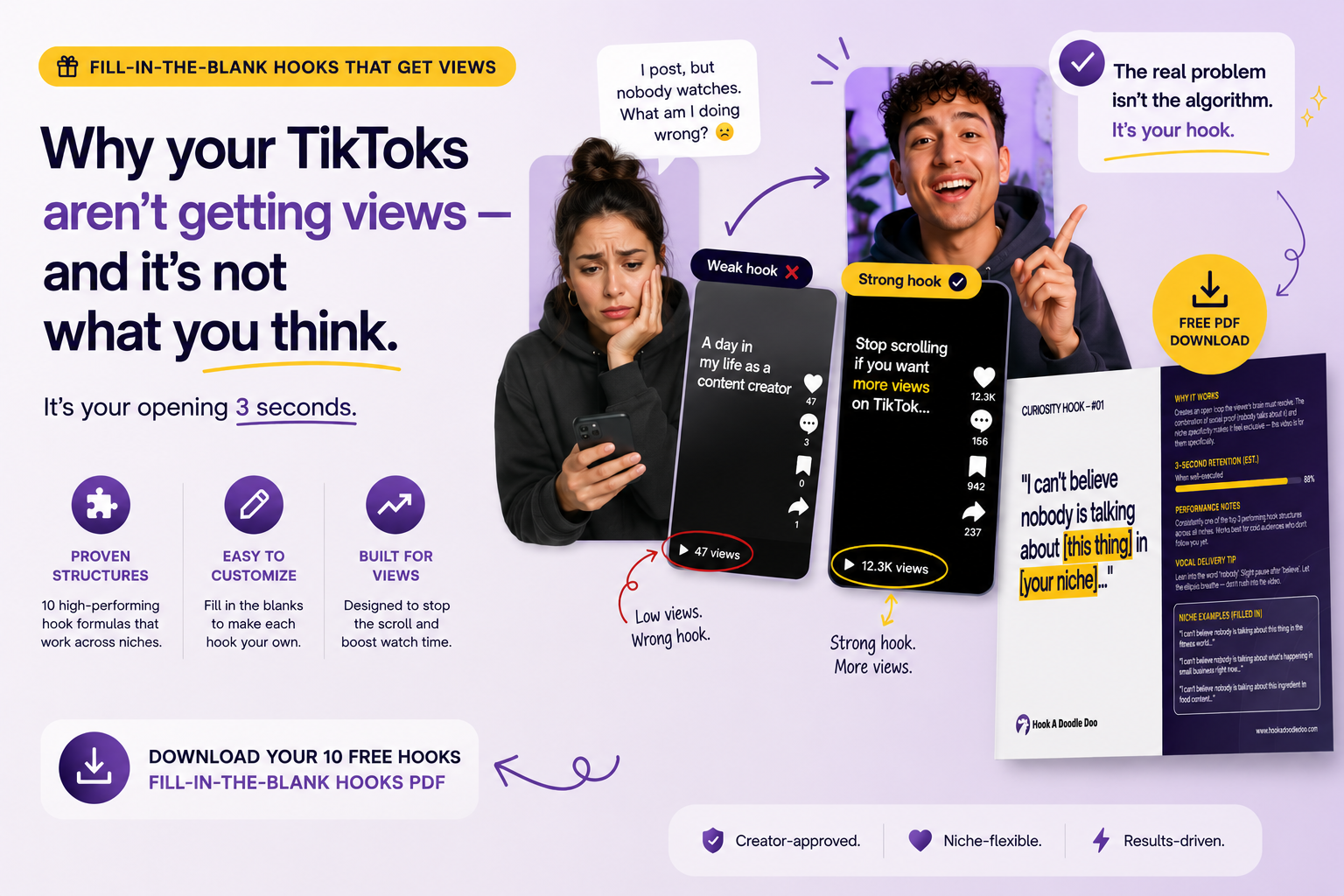
SOUND FAMILIAR?
You're posting every day. You've watched every TikTok growth video on YouTube. You've tried trending audio, you've used the recommended hashtags, you've posted at the "right" times. And your videos are still getting 200 views. Maybe 300. A few random ones hit a couple of thousand and then go silent again. You're doing everything right and nothing is working.
If that describes you, this post is going to be uncomfortable to read – because the reason your TikToks aren't getting views is almost certainly not what you've been told it is. It's not the algorithm being unfair. It's not your follower count being too low. It's not your posting schedule, your hashtags, or your niche being too competitive.
It's your hook. And more specifically, it's what happens in the first three seconds of every video you make.
Before we get into exactly why, let's run through the four most common explanations creators give for low views – and what the data actually says about each one.
The four myths creators blame for low views
MYTH 1
"The algorithm is shadowbanning me." The shadowban is the most persistent myth in TikTok creator culture. There is no evidence that TikTok operates a deliberate shadowban system. What creators experience as a shadowban is almost always the algorithm receiving a poor retention signal – typically a low hook rate – and deprioritising the content as a result. The content isn't hidden. It's being shown to fewer people because the signal says fewer people want to watch it.
MYTH 2
"I don't have enough followers yet." TikTok is the most democratised distribution system in the history of social media. A zero-follower account posting its first video can reach 100,000 people if the retention signals are strong. Follower count is almost irrelevant to distribution for new videos. What matters is how the small test audience TikTok first shows your video to responds to it – and that response is determined almost entirely by your hook.
MYTH 3
"I need to use trending audio." A creator named Emily Hessney Lynch ran a documented week-long experiment adding trending sounds to every TikTok video. The result: while she gained some likes and comments, she saw drops in video views, profile visits, and shares. Trending audio adds some discovery potential within that sound's community but does not substitute for a strong hook – and often distracts from it.
MYTH 4
"My niche is too competitive." Competition on TikTok affects discoverability through search and hashtags – it does not affect For You Page distribution, which is where the vast majority of views come from. A video with a strong hook in a competitive niche will outperform a video with a weak hook in an empty niche every time, because the algorithm distributes based on retention signals, not category popularity.
THE ACTUAL REASON
Your hook rate is below the threshold for meaningful distribution. TikTok measures the percentage of viewers who make it past the first three seconds of your video. This metric — your hook rate — is assessed before any other signal. If it falls below roughly 65%, the algorithm interprets the content as low-value and limits its distribution. No amount of posting consistency, trending audio, or hashtag optimisation overrides a consistently low hook rate.
How TikTok actually decides who sees your video
Understanding this mechanism is the single most useful thing you can do as a creator – because it reveals exactly where in the process things are going wrong for most people.
When you post a video, TikTok does not show it to your followers first and then decide whether to push it further. TikTok tests the new video with a small group of viewers first before deciding whether to expand distribution. The system watches how people react – if viewers watch all the way through, rewatch it, comment, or share, the platform pushes the video to more audiences. If viewers scroll away quickly the system slows distribution and begins testing other content instead.
70%
The new completion rate benchmark for viral potential in 2026. Up from 50% in 2024. TikTok's algorithm updated in late 2025 with follower engagement now central to distribution – and the completion rate threshold for viral potential increased to 70%, up from 50% the previous year. Your hooks need to be stronger than ever.
This is why two creators in the same niche, posting at the same frequency, with similar production quality can have completely different results. The one with the higher hook rate gets pushed further in each test cycle. The one with the lower hook rate gets deprioritised after the first small audience and never reaches momentum.
The table below shows how the same underlying problem – a low hook rate – gets misdiagnosed as several different issues depending on what the creator chooses to focus on:
WHAT YOU OBSERVE
Views stuck at 200–300
WHAT CREATORS BLAME
Algorithm not pushing content
WHAT'S ACTUALLY HAPPENING
Hook rate below threshold – small test audience dropped off, distribution stopped
WHAT YOU OBSERVE
One video hits 10k, next gets 200
WHAT CREATORS BLAME
Algorithm is random / inconsistent
WHAT'S ACTUALLY HAPPENING
Hook rate variance — one hook worked, the next didn't, test audience responded differently
WHAT YOU OBSERVE
Views drop after a few days
WHAT CREATORS BLAME
Algorithm stopped pushing it
WHAT'S ACTUALLY HAPPENING
Normal distribution cycle — most content peaks at 48–72 hours unless rewatch rate is high
WHAT YOU OBSERVE
Similar creator gets more views
WHAT CREATORS BLAME
They have more followers / are more established
WHAT'S ACTUALLY HAPPENING
Their hook rate is higher – their test audience stays, the algorithm pushes further
WHAT YOU OBSERVE
Trending audio video underperformed
WHAT CREATORS BLAME
Used the wrong trend
WHAT'S ACTUALLY HAPPENING
Hook was weak regardless of audio – the sound attracted a different audience than the content served
The 4 real suspects behind low views
If the root cause is always the hook, the specific failure can be one of four things. Understanding which one is affecting your account tells you exactly what to change.
1. A weak opening line
The most common cause. The first sentence out of your mouth does not create curiosity, promise a result, challenge a belief, or interrupt a pattern. It starts with context, introduction, or explanation — none of which stop a scroll. By the time you say something interesting, 60% of your test audience has already left.
The fix: Rewrite the opening sentence of your last 5 videos using a fill-in-the-blank hook template. Film them again. Compare the retention graphs at 24 hours.
2. A strong hook with a slow start
Sometimes the hook itself is good but there is a gap – a pause, an intro graphic, a logo animation, a "hey guys welcome back" — between the hook and the substance. TikTok now requires a 70%+ completion rate for viral distribution in 2026 – every second of dead time in the first ten seconds costs you audience. Viewers who stayed for the hook leave during the dead space.
The fix: Remove everything from the first 10 seconds that is not the hook and the immediate substance that follows it. No intro. No logo. No "before I start". Jump straight into the content.
3. A hook that attracts the wrong audience
A hook can be technically strong – it stops the scroll – but attract viewers who are not your target audience. Those viewers stay for three seconds and leave at five when they realise the content is not for them. This produces a good hook rate but a poor overall completion rate, which confuses the distribution signal. Low views on TikTok is often because the algorithm doesn't know how to categorise the content – using keywords in videos, text on screen, and descriptions tells TikTok exactly where to place it.
The fix: Add your niche explicitly to the hook itself. Not just "nobody talks about this" – but "nobody talks about this in the fitness world." The niche qualifier filters for the right audience from the first word.
4. Inconsistent hook quality across videos
One strong hook followed by five weak ones creates an inconsistent distribution pattern – occasional spikes surrounded by flat videos. The algorithm cannot build a reliable model of your content's value if the retention signals vary wildly from post to post. Consistency of hook quality is as important as frequency of posting.
The fix: Write your hook before you film anything else. Treat it as a separate creative task. If you cannot articulate the hook in one sentence before filming, you are not ready to film yet.
How to diagnose your own account in 10 minutes
You do not need to guess which of these four suspects is affecting your account. TikTok tells you directly inside its analytics – most creators just do not know where to look.
Finding your hook rate in TikTok Studio
1. Open TikTok Studio (studio.tiktok.com on desktop, or the Creator Tools section in the app)
2. Go to Content and select any video posted in the last 30 days
3. Scroll down to find the Audience Retention graph – this shows you exactly when viewers are leaving your video
4. Look at the first 3 seconds of the graph. A sharp drop here = hook problem. A gradual drop starting at 5–8 seconds = hook worked, content didn't deliver on the promise
5. Check this for your last 10 videos and note the pattern. If the first-3-second drop is consistent across videos, your hook writing is the single thing to change
WHAT THE NUMBERS MEAN
Below 50% retention at 3 seconds = the hook is actively hurting you. 50–65% = weak, needs improvement. 65–75% = solid, keep refining. Above 75% = strong hook – now focus on the rest of the video holding up to the same standard.
The fix – what to do this week
The good news is that a hook problem is the most fixable problem in content creation. You do not need better equipment, a larger following, or a different niche. You need a different first sentence.
Here is a practical five-day reset:
Day 1: Pull up the retention graphs for your last 10 videos. Write down where viewers are dropping off in each one. This is your baseline — the honest picture of where the problem actually lives.
Day 2: Take the video with the worst hook rate. Rewrite its opening line using one of the three hook structures – open loop, specific result, or pattern break. Film only the first five seconds. Compare them and pick the strongest one.
Day 3: Before filming your next video, write the hook first. Not a topic. Not an outline. A hook – one sentence that starts the video. If you cannot write it in under two minutes, you do not have a clear enough idea yet.
Day 4: Post the video. Read the hook out loud immediately before filming – if it sounds scripted swap one word. The hook should sound like the way you actually talk, not the way you write.
Day 5: Check the retention graph 24 hours after posting. Compare the first-3-second drop to your baseline from Day 1. Even a 10 percentage point improvement is significant – that is the hook working. Repeat the process for the next video.
THE ONE RULE TO REMEMBER
Never film a TikTok before you have written the hook. The hook is not the introduction to your video – it is the reason your video gets watched. Write it first, every time, without exception. Everything else about your content can improve gradually. This one discipline change produces results within a week.
What comes after the hook
Fixing your hook rate is the first step – and for most creators it is the only step needed to restart growth. High-quality content creators get 72% more watch time per video view and more than 40 times greater follower growth than low-quality counterparts – but high-quality starts with the first second, not the production value.
Once your hook rate is consistently above 65%, the next variable to improve is completion rate – the percentage of viewers who make it to the end of your video. That is a different problem, solvable with pacing and content structure. But there is no point addressing it until the hook is working, because without a strong hook the completion rate is irrelevant – nobody is getting far enough into the video to complete it.
Fix the hook first. Everything else follows.